Back

EW vs. Drone: How to Save Pegasus Arms 25 from Jammers

EW vs. Drone: How to Save Pegasus Arms 25 from Jammers

11.02.2026

The modern front line is not just trenches and minefields. It is a dense "electromagnetic soup." Enemy Electronic Warfare (EW) assets operate 24/7, attempting to turn expensive strike drones into helpless chunks of plastic and metal.

At Pegasus Arms, we know the cost of every lost bird. That is why we engineer the Pegasus Arms 25 with harsh countermeasures in mind. But even the most hardened communication link is only 50% of success. The other 50% is the pilot's composure and tactics.

What Does EW Do to a Drone?

The enemy does not stand still. The main threats faced by a heavy drone operator include:

  1. Control Link Suppression: The drone stops responding to commands, hovers, or (worst case) lands in enemy territory.
  2. Video Loss: "Snow" on the screen or total blackout. The pilot loses orientation.
  3. GPS Spoofing: The drone is tricked into "thinking" it is at a civilian airport (or in the middle of the sea) and tries to "Return to Home," flying straight into enemy lines.

The Answer from Pegasus Arms Engineers

We did our homework. Our systems are equipped with communication modules operating on non-standard frequencies and utilizing Frequency Hopping Spread Spectrum (FHSS) algorithms. This makes it difficult for enemy EW stations to "catch" and jam our signal.

Furthermore, the Pegasus Arms 25 flies stably in fully GPS-denied environments.

The Pilot Factor: Cunning vs. Power

However, "unjammable" drones do not exist. If a pilot acts predictably, they will be neutralized.

This is why we insist on certified training at HTEC "MIST". They teach you not just to push sticks, but to feel the airwaves.

What is taught in the Counter-EW module:

  • Diagnosis: How to recognize in a split second that you are being jammed (input lag, bitrate drop, erratic compass behavior).
  • Blind Flying: Operating without GPS stabilization (ATTI mode). This is advanced piloting, where the operator manually stabilizes the heavy aircraft against wind and inertia.
  • Terrain Masking: How to hide behind hills or tree lines to break the line of sight (LOS) with the enemy jammer.
  • Emergency Protocols: What to do when the link is lost? (Our drone features Smart RTH settings, but the pilot must know how to configure them pre-flight).

Conclusion

The Pegasus Arms 25 complex gives you the technical edge. Training at HTEC "MIST" gives you the tactical edge. Combine these two factors, and enemy EW becomes not a barrier, but merely a temporary inconvenience.

👉 Enroll in Pegasus Arms 25 Operator Training: UAV Operator Course PEGASUS ARMS 25

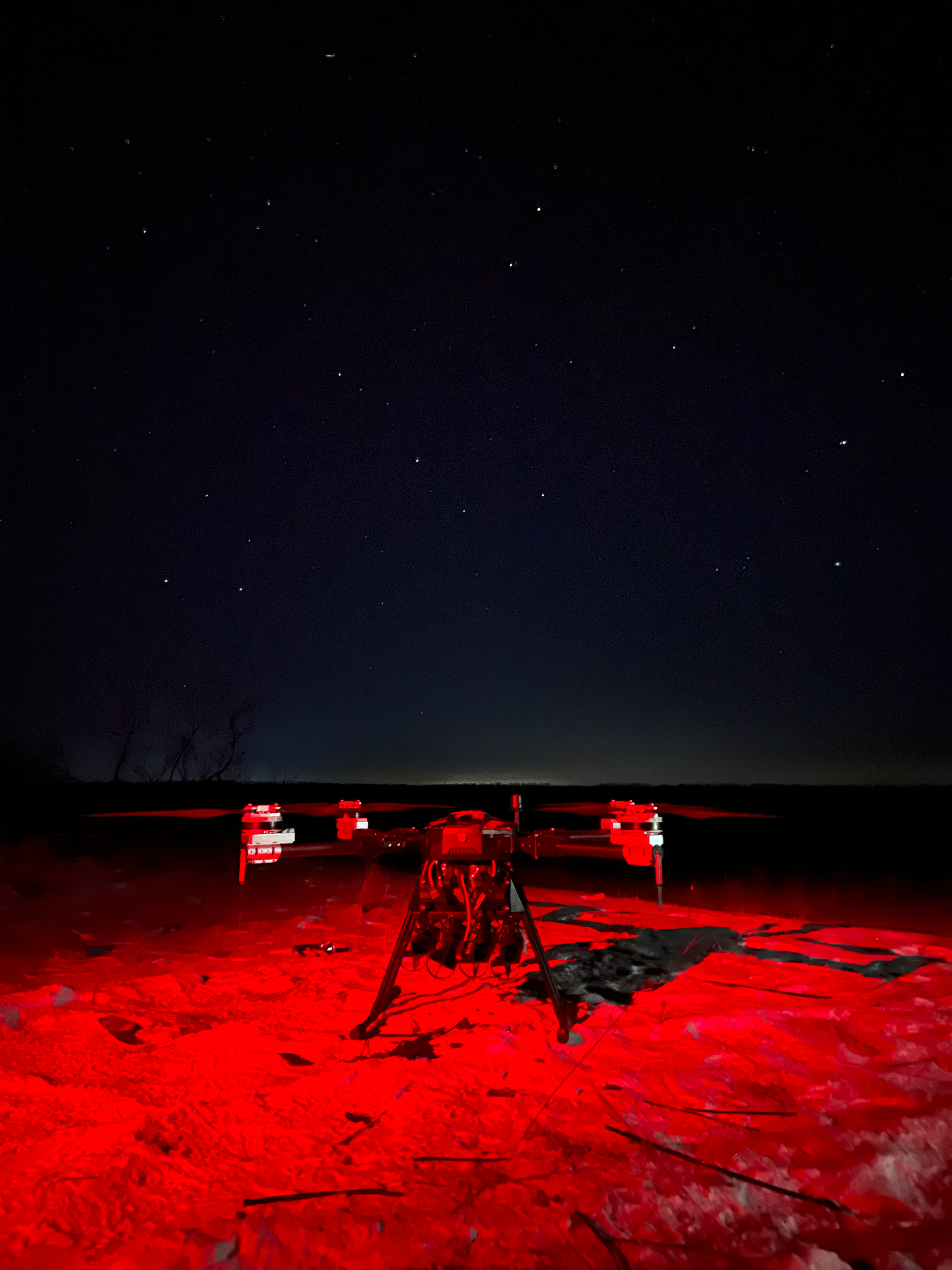
Night Flight Uas

You may be interested

How to Become a Drone Operator for Free and with a Guarantee

How to Become a Drone Operator for Free and with a Guarantee

When our company developed the heavy strike complex Pegasus Arms 25, we faced an obvious question: who will pilot it? There is a critical shortage of qualified crews for heavy multirotors on the front lines.

Meanwhile, thousands of people search online daily on how to become a drone operator, hoping to join aerial reconnaissance after mobilization. Most of them make a fatal mistake—they wait, assuming the "army will teach them everything." However, the reality is different: if you arrive without a confirmed profession, you are assigned where there is the greatest shortage of personnel. Most often, this is regular infantry, not the control panel of a high-tech UAV.

If you are looking for a way to guarantee becoming a drone operator, there is only one solution: obtain a state certificate and a Military Occupational Specialty (MOS) before the system decides for you.

The Path to the Elite: How to Become a Pegasus Arms 25 Strike Drone Operator from Scratch

The Path to the Elite: How to Become a Pegasus Arms 25 Strike Drone Operator from Scratch

As a manufacturer of heavy unmanned aerial systems, the Pegasus Arms team frequently receives messages like: "I am a civilian planning to mobilize. How can I become a pilot for your bombers?"

The desire is completely understandable. Operating a powerful strike multirotor is a prestigious profession that allows you to inflict maximum damage on the enemy while remaining at a relative distance from the front lines. However, if you simply show up at a Recruitment Center (TCC) wanting to "fly," you will most likely be assigned wherever there is a critical shortage of personnel (such as regular infantry).

To become a UAV operator, you need a strategy. Here is a step-by-step guide from the manufacturer on how a civilian can guarantee their place at the controls of our complex

Heavy Bomber Drones: Evolution of the Ukrainian Strike Fleet

Heavy Bomber Drones: Evolution of the Ukrainian Strike Fleet

The drone war in Ukraine is undergoing rapid evolution. While 2024 was the year of mass proliferation of FPV kamikaze drones, 2026 is becoming the year of heavy reusable bombers and systematic night operations.

The market is saturated with "disposable" solutions, but experience shows that destroying fortifications and heavy armor requires a different class of "birds." The Pegasus Arms team (a subsidiary of MartynTech) analyzes why the future belongs to heavy multi-rotor systems.